
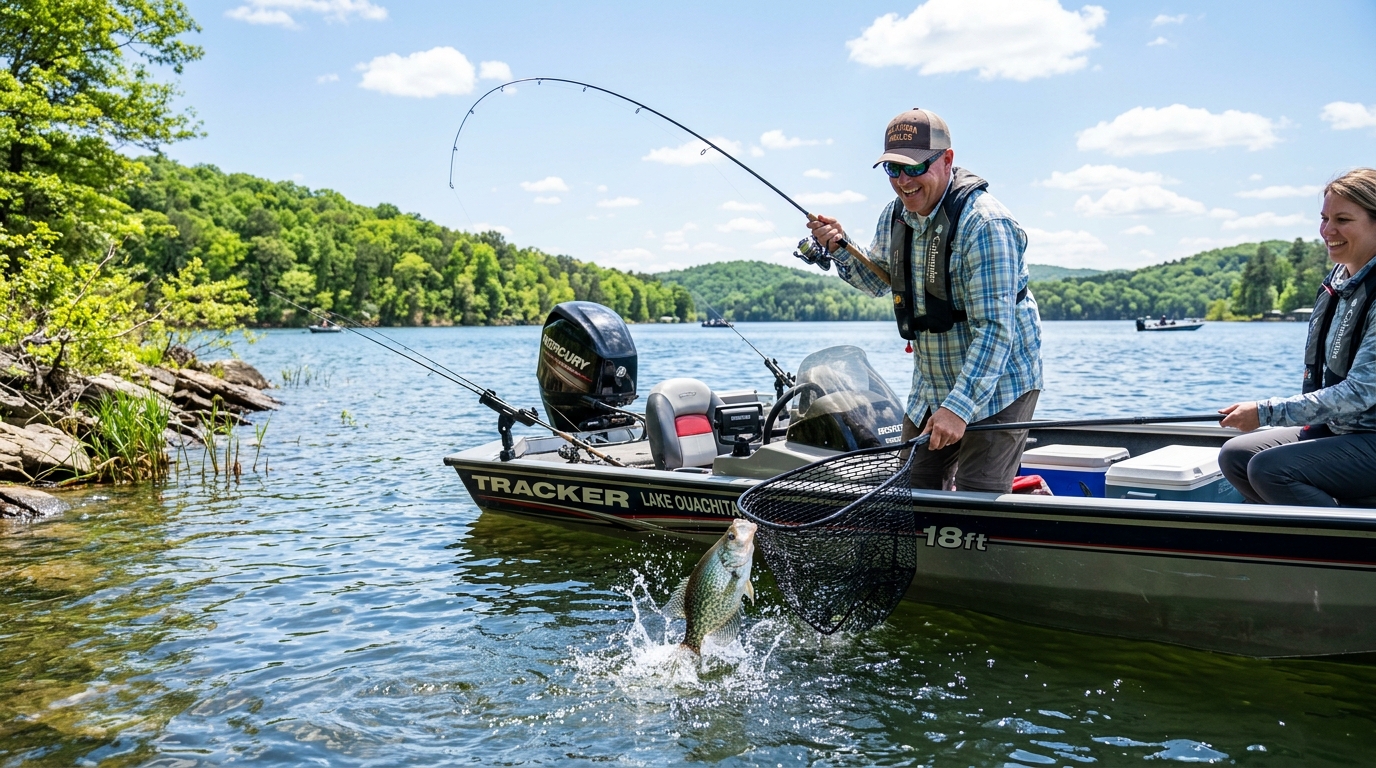
The crappie spawn is not subtle. When water temperatures climb into the upper fifties, schools of black and white crappie move from deep wintering holes into shallow cover with a single purpose. They build nests, pair off, and defend their territory with an aggression that turns ordinarily cautious fish into reckless attackers. Miss this window and you are fishing for post-spawn crappie that have scattered, gone deep, and returned to the skittish behavior that earned them the nickname "papermouth." Hit it right and you can catch a limit in an hour.
For more on this topic, see our guides on Spring Bass Fishing, Panfish Tactics.
The window is wider than most anglers realize. Crappie do not all spawn at once. They spawn in waves, triggered by water temperature, moon phase, and individual readiness. On a single lake, the first wave might start in late March while the last wave finishes in early June. That means productive fishing can stretch across a six to eight week period even on one body of water. The anglers who understand how to move with the fish as they progress through the spawn and into post-spawn patterns catch fish long after the first wave of weekend warriors has given up and gone home.
Reading the Spawn: Water Temperature and Timing
The single most reliable trigger for crappie spawning activity is water temperature. When surface readings hit fifty-eight to sixty-four degrees, crappie begin moving toward shallow brush, timber, and vegetation to build nests. This range is consistent across most of the country, though the calendar date changes dramatically depending on latitude. Southern reservoirs may see spawning crappie in late February. Northern lakes might not see them until late May.
Do not trust a single reading. Water temperature varies by depth, exposure, and current. A north-facing pocket with a dark mud bottom and no wind exposure may be five degrees warmer than the main lake. A creek fed by cold spring water may be five degrees cooler. You need to check multiple areas and look for the warmest shallow water with the right cover. That is where the first wave of spawners will set up.
Moon phase adds another layer. Crappie spawn activity intensifies around the full and new moons, particularly when those moon phases coincide with the right water temperature. A full moon in early April when the water is sixty-two degrees is prime time. The same moon phase two weeks earlier when the water is still fifty-four degrees might produce nothing. The combination of temperature and lunar pull is what moves fish onto beds in numbers.
Local knowledge matters here. Every lake has its own personality. A reservoir with a stable water level and abundant timber will spawn earlier than a flood-control lake that fluctuates wildly. A small farm pond with no inflow warms faster than a thousand-acre reservoir with current. The general rules get you in the ballpark. The specific adjustments come from time on the water.
Where to Find Spawning Crappie
Spawning crappie need three things: shallow water, cover to build nests against, and enough light for their eggs to develop. Find all three in one place and you have found a crappie factory.
Shallow-water crappie during the spawn can be caught in water as shallow as one to three feet when the right cover is present. Wood is king. Submerged timber, brush piles, stake beds, and fallen trees all hold spawning crappie. The fish orient to the thick stuff, building nests in the root systems and branch clusters where their eggs are protected from predators and where current cannot wash them away.
Vegetation also holds fish, though not always in the same densities as wood. Cattails, milfoil, and coontail can all host spawning crappie, particularly in lakes where timber is scarce. Look for isolated clumps or edges where the vegetation meets open water. Crappie do not like to spawn deep inside thick grass where they cannot see approaching threats.
Dock pilings and seawalls are frequently overlooked. The shade, cover, and bottom structure around docks create ideal nest sites, and crappie that have seen heavy fishing pressure in traditional brush piles may move to dock complexes to escape the pressure. Skip docks at your own risk during the spawn.
Creek channels and backwater sloughs are classic spawning areas because they warm quickly in spring and offer a buffet of brush and timber. The mouths of creeks where they intersect the main lake are transition zones where pre-spawn fish stage before moving all the way back. During the spawn, work all the way into the back of the creek where the cover is thickest.
The key to finding fish is covering water efficiently until you locate the first active fish. Once you find one spawning crappie, there are almost always more nearby. Crappie bed in colonies, and a single brush pile might hold a dozen or more nests in a space no larger than your living room.
The Tactics That Dominate the Spawn
Vertical jigging is the most effective technique for spawning crappie, and it is not close. The fish are holding tight to cover, often suspended in the branches or hovering just above the nest. A cast-and-retrieve approach will snag every time. You need to drop a lure straight down, keep it in the strike zone, and tempt the fish into biting.
The standard rig is a one-sixteenth to one-thirty-second ounce jig head tipped with a minnow or soft plastic body. The light weight is critical. A heavy jig falls too fast, snags too easily, and looks unnatural. The light jig flutters down through the branches, giving crappie time to inspect it and commit.
- Minnow-tipped jigs — Live minnows are the confidence bait for crappie anglers, and for good reason. A lively minnow on a light jig head is irresistible to a territorial crappie. Hook the minnow through the lips or behind the dorsal fin. A lip-hooked minnow stays alive longer and swims more naturally. Change minnows frequently — a dead or lethargic bait gets far fewer bites.
- Soft plastics — Modern crappie plastics like Bobby Garland Baby Shads and Strike King Mr. Crappie tubes imitate minnows with remarkable accuracy and can outfish live bait on pressured fish. The advantage is durability — one plastic body lasts twenty or thirty fish. The disadvantage is that plastics lack the subtle vibration and scent of a live minnow. Experiment with both and let the fish tell you what they want.
- Bobber setups — A fixed or slip bobber rigged eighteen to thirty inches above a minnow or jig lets you suspend the bait at a precise depth and keep it in front of holding fish. Bobber fishing is particularly deadly when crappie are tucked inside thick brush and a free-falling jig would snag instantly. The vertical presentation mimics a minnow suspended in the cover.
- Long-pole jigging — Tournament crappie anglers use telescoping poles fourteen to sixteen feet long to reach brush piles that casting cannot touch. The pole is held vertically, the jig is lowered straight down, and the angler jigs with short twitches of the wrist. When a fish bites, the pole is lifted straight up, driving the hook and bringing the fish clear of the cover in one motion.
- Tightlining — This is vertical jigging without a bobber, using only the line tension to feel bites. It requires sensitive equipment and a steady hand, but it offers the most direct connection to the fish and works best in heavy timber where a bobber would hang on every branch.
Color selection during the spawn is less important than most anglers think. Research and tournament data consistently show that black-and-chartreuse, pink, and white are the top producers nationwide. In clear water, natural colors like silver and smoke work well. In stained water, bright colors like chartreuse, orange, and electric chicken get more visibility. If you are not getting bites on one color, switch. Do not overthink it.
The retrieve matters more than color._spawn. Aggressive crappie want a lure that acts wounded. A sharp twitch followed by a two-second pause triggers more strikes than a steady retrieve. The fish are not chasing — they are ambushing. Give them a slow, vulnerable target.
Targeting Male Crappie: The Spawn Secret
This is the detail that separates anglers who catch limits from anglers who scratch out a few fish. Male crappie stay on the nests longer than females. Once a female drops her eggs, she moves off to recover in slightly deeper water. The male stays behind to guard the nest, and he does not leave until the eggs hatch.
That makes male crappie the most catchable fish in the lake during the spawn. They are territorial, aggressive, and stationed in predictable locations. A female might cruise through, look at your lure, and drift away. A male on a nest will attack anything that enters his zone — including your jig, your bobber, and occasionally your line if it swings too close.
The trick is identifying which fish are males. During the spawn, male crappie often develop dark coloration, particularly on their heads and fins. Black crappie males turn almost jet black. White crappie males darken significantly. The color change is tied to hormones and territorial behavior, and it is a reliable indicator that the fish is guarding a nest.
Fish the cover thoroughly. If you catch a dark-colored crappie from a brush pile, keep working that same piece of cover. There are likely multiple males on nests throughout the structure. Drop your jig into every gap, every pocket, and every shadow within the brush pile. Males are spread out, defending individual territories, so you need to probe the entire area.
The females are still catchable, but they require a different approach. Post-spawn females move to the outer edges of the spawning area, holding in eight to twelve feet near the break line. They are less aggressive, more scattered, and harder to pattern. If you want numbers during the spawn, target males. If you want slabs, target post-spawn females on the deeper edges once the main spawn is over.
The Post-Spawn Shift: May and June Patterns
After the spawn, crappie behavior changes fast. The males leave the nests. The females recover in deeper water. The entire population scatters along channel edges, timber lines, and brush piles in eight to fifteen feet. The shallow-water bite dies, and anglers who keep fishing the same brush piles they hammered in April will wonder where the fish went.
The post-spawn pattern is about structure and depth. Crappie need cover, but they also need proximity to deep water. Channel ledges, humps, and points that drop into fifteen to twenty-five feet are the new highways. Brush piles placed on these breaks — whether natural or man-made — hold post-spawn fish from May through June and into early summer.
Vertical jigging still works, but the technique shifts. Instead of fishing in two to four feet of timber, you are now fishing ten to fourteen feet along a channel edge. A fish finder is almost essential for this phase. You need to see the brush pile, see the crappie suspended over it, and drop your jig to the exact depth where the fish are holding.
Trolling is another effective post-spawn tactic. A spread of small cranks or spider rigs pulled along channel edges covers water and locates scattered schools. Once you find fish, you can stop and vertical jig or continue trolling through the school. Post-spawn crappie often school tighter than people expect — find one and you have found thirty.
Depth changes with the season. In May, post-spawn crappie might be in eight to ten feet. By late June, they may have slid to fifteen or twenty feet. Follow the thermocline if your lake develops one. Crappie prefer water in the sixty-five to seventy-five degree range, and they will adjust their depth to find it.
The Panfish Double: Catching Bluegill and Shellcracker in the Same Trip
While crappie get the headlines, bluegill and shellcracker spawn in overlapping waves during late spring. Their peak activity often coincides with the crappie spawn, which means an angler with the right plan can catch three species in a single morning.
Bluegill spawn when water temperatures hit sixty-eight to seventy-five degrees, which is typically just after or alongside the crappie spawn. They build nests in colonies on firm bottoms — sand, gravel, or clay — in one to four feet of water. Look for beds along shorelines, around docks, and in the same backwater pockets where crappie are spawning. The telltale sign is a cluster of saucer-shaped depressions in the bottom, often in water so shallow you can see the beds from the bank.
Shellcracker, also called redear sunfish, spawn a little later and prefer slightly deeper water. They target the same areas as bluegill but tend to hold in three to six feet. Shellcracker fight harder than bluegill and grow larger, making them a prized target for anglers who know where to find them.
The tactics for panfish differ from crappie tactics. Bluegill and shellcracker are bottom-oriented during the spawn, and they respond to small baits fished slowly. A split-shot rig with a small hook and a piece of worm or cricket is the classic presentation. Small jigs tipped with wax worms or mealworms also work. The key is keeping the bait on or near the bottom and fished with a slow, dragging retrieve.
One of the best strategies for a multi-species day is to start in the back of a creek targeting crappie in the timber. Once the crappie bite slows, move to the shallower flats at the mouth of the creek where bluegill beds are visible. If the day is warming and the water temperature is climbing, slide deeper to find shellcracker along the first drop-off. You follow the temperature gradient and fish each species where it is most active.
Common Mistakes Crappie Anglers Make in Spring
The first mistake is fishing too deep during the spawn. Pre-spawn crappie may hold in twelve to twenty feet, but once the spawn starts, the fish you are targeting are shallow. If your bobber is set at eight feet and the crappie are bedding in two feet, you will never get a bite. Check the depth of the cover. If it is in four feet of water, your bait needs to be in four feet of water.
The second mistake is using tackle that is too heavy. A crappie has a paper-thin mouth. Heavy line, stiff rods, and large hooks tear out on the hookset and cost you fish. Use four to six pound test monofilament or fluorocarbon, a light-action rod with a soft tip, and small jig heads with sharp hooks. The goal is a hookset that penetrates without ripping a hole in the fish's jaw.
The third mistake is fishing too fast. Spring crappie, particularly spawning males, are aggressive but not fast. A lure that zips past a nest gets ignored. A lure that lingers, twitches, and tempts gets eaten. Slow down. Count to five between twitches. Let the minnow swim. Give the fish time to commit.
The final mistake is ignoring the spawn timing on your specific lake. National crappie spawn charts are useful orientation tools, but they are not gospel. A nearby lake with no current, a dark bottom, and protected coves may spawn two weeks earlier than a main reservoir with constant current and a light-colored bottom. The only reliable indicator is what is happening when you put your lure in the water.
Bottom Line: Spring and early summer offer the most predictable crappie fishing of the entire year. The fish are shallow, aggressive, and concentrated in specific types of cover. You do not need expensive electronics, a fast boat, or a guide's secrets. You need a light rod, a bucket of minnows or a few jig heads, and the patience to work brush piles thoroughly until you find the active fish.
The spawn window is wider than most anglers realize. Waves of crappie move into shallow cover over a period of weeks, and post-spawn fish follow predictable patterns into deeper structure. The anglers who stay on the water, adjust with the fish, and fish each phase with the right tactics catch limits when everyone else is struggling.
A true slab crappie — a fish over fourteen inches — is most likely during the spawn. Male crappie guarding nests are aggressive enough to take big baits, and the females moving in to drop eggs are at their heaviest. Post-spawn fish recover and slim down. Spawn fish are thick, angry, and catchable. Do not miss this window.
Plan your next crappie trip with confidence. bieldfish.com helps anglers track water temperatures, find productive structure, and log patterns that repeat year after year on their home lakes.